Gear Innovation
Contact usEntanglements occur when fishing ropes, nets, or marine debris become attached or wrap around a whale as it swims, which can restrict movement and result in serious injury or death. In 2024, large whale entanglements were confirmed off the coasts of 12 states, with more than 71% observed off California, Massachusetts, Alaska, and Hawaii. Humpback whales were the most frequently entangled species, followed by gray whales, North Atlantic right whales, minke whales, sperm whales, fin whales, and bowhead whales. Approximately 48 percent of confirmed cases involved commercial or recreational fishing gear such as traps, nets, and monofilament lines, while the remaining cases involved line that could not be directly linked to a specific source.
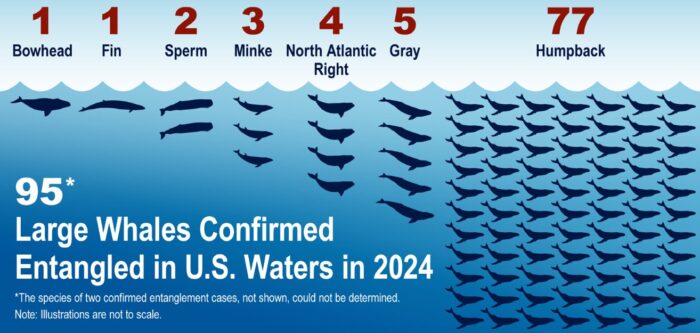
Source: NOAA
On the U.S. West Coast, whale entanglements increased significantly beginning in 2014, from an average of 8 per year between 1982 and 2013 to 34 per year from 2014 to 2022. Most entanglements are reported off the coast of California, where fixed gear fisheries, such as trap/pot and gillnet operations are prevalent. While the specific source is often unknown, most confirmed cases involve Dungeness crab gear. Humpback whales are the most commonly entangled species, though entanglements have also been documented for several other whale species and leatherback sea turtles. In 2024, 36 entanglements were confirmed along the West Coast, the highest total reported since 2018.
In response, state and federal fishery managers, in consultation with industry leaders and other stakeholders, are collaboratively working to identify and implement solutions to reduce entanglement risk in the Dungeness crab fishery and other fixed gear fisheries. As part of these efforts, the Foundation supports a collaborative initiative to trial innovative fishing gear that offers potential solutions to reduce entanglement risk while allowing fishing to continue. In partnership with fishermen, gear manufacturers, fishery managers, and other stakeholders, we provide access to gear, training, and support to test a range of technologies under real-world fishing conditions. Results from these trials will inform additional testing, guide technology development, and support the potential approval of innovative gear for use in California trap fisheries, providing fishermen with opportunities to continue fishing in areas where traditional gear is restricted due to entanglement risk.
Gear testing is primarily taking place off California’s central coast, an area that has regularly experienced closures due to whale presence and entanglement risk.
Technologies currently being tested include pop-up or on-demand gear, which reduce the amount of time buoy lines are present in the water column and thereby lower the risk of entanglements with whales and sea turtles. These systems use acoustic or timed-release mechanisms to deploy a stowed rope and buoy, buoyant spool, or lift bag to the surface, allowing fishermen to retrieve gear without persistent vertical lines.

To expand testing opportunities, the Foundation created an innovative gear library to offer fishermen access to gear from multiple manufacturers. Fishermen can borrow gear for testing and, in exchange, provide performance data and feedback to help improve the technologies.
Key partners and advisors include the California Ocean Protection Council, California Department of Fish and Wildlife, National Oceanic and Atmospheric Administration, West Coast National Marine Sanctuaries, California Dungeness Crab Fishing Gear Working Group, and fishermen collaborators.
Testing Activity Updates
Testing activities are ongoing. As of June 30, 2025, participating fishermen have carried out 880 trials using six different pop-up fishing systems.
Photo: Timmy Reyes 2024
“Innovative fishing gears are a promising option to reduce the frequency and severity of marine life entanglements. However, a thoughtful and systematic approach to testing is necessary to determine the suitability of specific gear innovations for the California Dungeness crab fishery. CDFW is proud to partner with the National Marine Sanctuary Foundation on this collaborative, science-based project.” – Craig Shuman, CDFW Marine Region
Photo: Greg Wells 2024
Resources
View the summary of the August 2022 gear innovation workshop